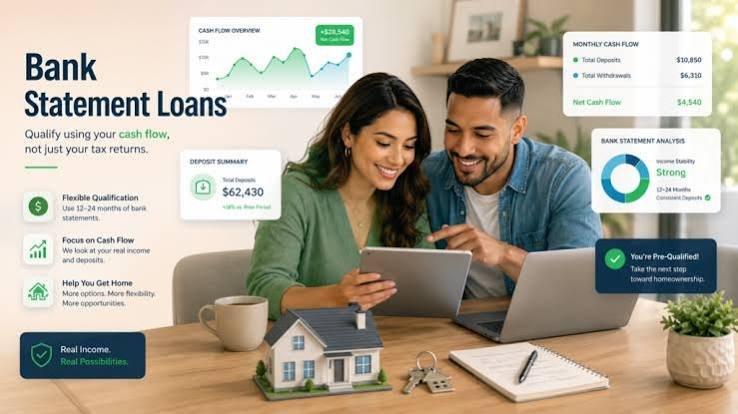

For self-employed professionals, entrepreneurs, freelancers, and business owners, qualifying for a traditional mortgage can be challenging. Tax deductions and business expenses often reduce taxable income, making it harder to meet conventional lending requirements. Fortunately, a bank statement mortgage offers an alternative solution.
In 2026, bank statement loans continue to be one of the most popular non-QM (Non-Qualified Mortgage) options for borrowers who have strong cash flow but don’t fit traditional income guidelines. Instead of relying on W-2s or tax returns, lenders evaluate your bank deposits to determine your ability to repay the loan.
What Is a Bank Statement Mortgage?
A bank statement mortgage is a home loan designed primarily for self-employed individuals. Rather than verifying income through tax returns or pay stubs, lenders review personal or business bank statements to estimate monthly income.
These loans are ideal for:
- Business owners
- Freelancers
- Independent contractors
- Consultants
- Gig workers
- Real estate agents
- Self-employed professionals
Because qualification focuses on cash flow, borrowers who maximize tax deductions may still qualify for financing.
How Does a Bank Statement Mortgage Work?
Instead of requiring traditional documentation, lenders analyze deposits shown on your bank statements.
Most lenders request:
- 12 to 24 months of personal bank statements
- 12 to 24 months of business bank statements
- Proof of self-employment
- Asset documentation
- Credit history
The lender calculates average monthly income based on consistent deposits and other financial factors.
Bank Statement Mortgage Requirements in 2026
Although requirements vary by lender, common guidelines include:
Minimum Credit Score
Most programs require:
- 620 to 700 credit score
- Higher scores may receive better interest rates
Self-Employment History
Borrowers typically need:
- At least two years of self-employment
- Proof that the business is active and generating income
Down Payment
Most lenders require:
- 10% to 20% down payment
Larger down payments may improve approval odds and lower rates.
Cash Reserves
Many lenders require:
- Three to twelve months of reserves
These funds demonstrate financial stability after closing.
Benefits of a Bank Statement Mortgage
No Tax Returns Required
One of the biggest advantages is avoiding the need to provide tax returns.
Flexible Income Verification
Income is based on actual cash flow rather than taxable income.
Ideal for Business Owners
Borrowers who claim significant deductions may qualify more easily than with conventional loans.
Purchase or Refinance Options
Bank statement loans can be used for:
- Primary residences
- Second homes
- Investment properties
- Rate-and-term refinancing
- Cash-out refinancing
Who Should Consider a Bank Statement Loan?
These loans are particularly suitable for:
- Self-employed borrowers
- Small business owners
- Entrepreneurs
- Doctors and attorneys with private practices
- Independent contractors
- Freelancers and gig workers
If your tax returns do not accurately reflect your earnings, a bank statement mortgage may provide the flexibility you need.
Pros and Cons
Advantages
- No W-2 forms required
- No tax returns required
- Flexible underwriting
- Higher loan amounts available
- Suitable for complex income situations
Disadvantages
- Interest rates may be higher than conventional loans
- Larger down payments are often required
- More documentation than some other non-QM programs
How to Improve Approval Chances
To strengthen your application:
- Maintain strong credit
- Avoid overdrafts and irregular deposits
- Keep sufficient cash reserves
- Organize bank statements before applying
- Work with lenders experienced in non-QM mortgages
Proper preparation can make the process smoother and increase your borrowing options.
FAQs
How many bank statements are required?
Most lenders require 12 to 24 months of statements.
Can I qualify without tax returns?
Yes. Bank statement mortgages are specifically designed for borrowers who prefer alternative income verification.
Are bank statement loans only for self-employed people?
Primarily, yes. These loans are intended for borrowers with nontraditional income sources.
Can I buy an investment property with a bank statement loan?
Yes. Many lenders allow purchases of primary residences, second homes, and investment properties.
What credit score is needed?
Most lenders require a minimum credit score between 620 and 700.
Conclusion
A bank statement mortgage can provide a valuable path to homeownership for self-employed borrowers in 2026. By focusing on actual cash flow rather than tax returns, these loans offer flexibility that traditional mortgages often lack.
If you’re a business owner, freelancer, or entrepreneur whose income doesn’t fit conventional guidelines, a bank statement loan could help you purchase or refinance a home while leveraging the strength of your business finances instead of your tax documents.
