
For veterans, active-duty service members, and eligible surviving spouses across Virginia, the VA home loan benefit is one of the most powerful financial tools available. Whether you’re stationed near Naval Station Norfolk in Hampton Roads, settling into the Fredericksburg corridor, or buying your first home in the Richmond metro or Roanoke Valley, understanding VA loan eligibility is the essential first step before you ever talk rates, lenders, or property listings.
The problem is that eligibility rules can feel genuinely confusing. Service period thresholds, entitlement calculations, Certificate of Eligibility requirements, funding fee exemptions: it’s a lot of terminology for something that should feel like a straightforward benefit you’ve already earned. This article is a structured, educational breakdown of exactly how VA loan eligibility works, written to give you clarity, not to sell you anything.
This guide covers who qualifies, what documentation you need, how lenders evaluate VA borrowers, and how to run the actual math before you commit to a loan. Think of it as the briefing you should have received before anyone started talking about interest rates.
Article by Duane Buziak, Mortgage Maestro, NMLS#1110647
The Foundation: What the VA Loan Program Actually Does
The VA Home Loan program is codified under Title 38 of the U.S. Code. Its purpose is straightforward: help eligible veterans, active-duty service members, certain National Guard and Reserve members, and qualifying surviving spouses purchase homes with favorable terms that would otherwise require significant cash reserves or strong conventional credit profiles.
Here’s the structural detail that matters most when you’re choosing a lender: the VA does not lend money directly. Private lenders, including banks, credit unions, and mortgage brokers, originate VA loans. The VA guarantees a portion of each loan, which reduces the lender’s risk and allows them to offer terms like zero down payment and no private mortgage insurance (PMI). That distinction between the VA as guarantor and the lender as originator has real implications for the rates and terms you’ll be offered, because not all lenders price VA loans the same way.
The table below provides an honest side-by-side comparison of VA, Conventional, and FHA loans on the metrics that matter most to most borrowers.
Loan Program Comparison Table
Down Payment: VA: 0% required for eligible borrowers with full entitlement | Conventional: Typically 3–20% depending on program and lender | FHA: Minimum 3.5% with qualifying credit score
Mortgage Insurance: VA: No PMI; one-time funding fee applies (exemptions exist) | Conventional: PMI required if down payment is below 20% | FHA: Upfront MIP plus annual MIP for the life of the loan in most cases
Credit Flexibility: VA: VA sets no minimum score; lenders typically require 580–640+ | Conventional: Generally requires stronger credit profiles for best terms | FHA: More flexible than conventional; lender overlays still apply
Occupancy Requirement: VA: Primary residence only | Conventional: Primary, second home, or investment | FHA: Primary residence only
Loan Limits: VA: No limit for full-entitlement borrowers (post-2020); county limits apply for partial entitlement | Conventional: Conforming limits apply; jumbo products available | FHA: FHA loan limits by county apply
The no-PMI feature alone makes the VA loan structurally superior for most eligible borrowers over the long term, but the math depends on your specific situation. We’ll work through that in detail in Section 6.
Service Requirements: Minimum Thresholds by Era and Branch
VA loan eligibility begins with service. The VA has established specific minimum service thresholds that vary depending on when and how you served. These are not arbitrary: they reflect the legislative history of the benefit and the different contexts in which military service has occurred across decades.
The following table summarizes minimum active-duty service requirements as published by the VA. Always verify current requirements at VA.gov before applying, as these guidelines can be updated by Congress.
Service Period and Minimum Requirements (Source: VA.gov)
World War II (Sept 16, 1940 – July 25, 1947): 90 days of active service
Post-WWII (July 26, 1947 – June 26, 1950): 181 days of continuous active service
Korean War (June 27, 1950 – Jan 31, 1955): 90 days of active service
Post-Korean (Feb 1, 1955 – Aug 4, 1964): 181 days of continuous active service
Vietnam War (Aug 5, 1964 – May 7, 1975): 90 days of active service
Post-Vietnam (May 8, 1975 – Sept 7, 1980): 181 days of continuous active service
Gulf War Era (Aug 2, 1990 – present): 24 continuous months of active service, OR 90 days of active service under Title 10 orders
National Guard / Reserve Members: 6 years of service in the Selected Reserve or National Guard, OR 90 days of active-duty service under Title 10 orders
The Gulf War era designation is still technically active, meaning most service members who have served since August 1990 fall under its requirements. If you enlisted after September 7, 1980, and served during peacetime before the Gulf War, the standard threshold is 181 continuous days.
There are important exceptions worth knowing. Service members who were discharged due to hardship, a reduction in force, certain medical conditions, or a service-connected disability may qualify with less than the standard minimum service. The VA evaluates these cases individually. This is not a loophole: it’s a recognition that not every abbreviated service period reflects a lack of commitment or sacrifice.
Surviving spouses of service members who died in the line of duty or from a service-connected disability may also be eligible for the VA loan benefit. Eligibility for surviving spouses is separate from the service member’s own service record and is governed by specific VA guidelines. The VA’s eligibility page at VA.gov provides the most current and complete guidance for surviving spouse cases.
One practical note for Virginia veterans: the Hampton Roads region has one of the highest concentrations of active-duty and veteran households in the country, and the Fredericksburg-Stafford corridor sees consistent VA loan activity given proximity to Marine Corps Base Quantico and Fort Belvoir. Lenders with genuine local experience in these markets understand the documentation timelines and appraisal nuances specific to these communities. If you’re a first time buyer in one of these corridors, working with someone who knows the local landscape makes a measurable difference.
Beyond Service: Credit, Income, and Occupancy Standards
Meeting the service threshold gets you to the eligibility table. What happens next involves lender-specific underwriting standards that the VA does not fully dictate. Understanding this distinction helps you shop smarter.
Credit Score: The VA itself does not impose a minimum credit score requirement. This is one of the program’s most important features. However, every individual lender sets its own overlay, and in practice, many lenders require scores in the range of 580 to 640 or higher. Some lenders set their floor at 620; others will work with scores in the high 500s depending on the overall file strength. This variation is exactly why working with a broker who can shop across hundreds of wholesale lenders matters: the same borrower profile that gets declined at one lender may be approved at another.
Debt-to-Income Ratio and Residual Income: The VA uses a dual-qualifier approach that no other major loan program replicates. In addition to reviewing your debt-to-income ratio, the VA requires lenders to verify that you have adequate residual income: the money left over after all major monthly obligations are paid. This includes housing costs, installment debt, revolving debt, and estimated maintenance costs.
The VA publishes regional residual income tables based on family size and loan amount. Virginia falls under the Northeast region in the VA’s residual income guidelines. A family of four purchasing with a VA loan in Virginia must meet the Northeast region’s minimum residual income threshold for that loan size. This requirement actually protects borrowers by ensuring the loan is sustainable, not just technically approvable on paper.
The VA’s general DTI guideline is 41%, though lenders may approve files above this threshold when residual income is strong. A borrower with a DTI of 45% but robust residual income is often approvable under VA guidelines where a conventional loan would require compensating factors or a denial.
Occupancy Requirement: VA loans are strictly for primary residences. The borrower must intend to occupy the property as their primary home, typically within 60 days of closing. For most Virginia buyers, this is straightforward. For active-duty borrowers who may be deployed or stationed elsewhere, there are specific provisions that allow a spouse or dependent to satisfy the occupancy requirement in certain circumstances. The VA evaluates these on a case-by-case basis.
Investment properties, vacation homes, and second residences do not qualify for VA financing. If you’re a Virginia real estate investor, programs like DSCR loans and conventional investment property financing are separate conversations entirely. VA financing is reserved for the home you’re actually going to live in.
Your Certificate of Eligibility: What It Is and How to Get It
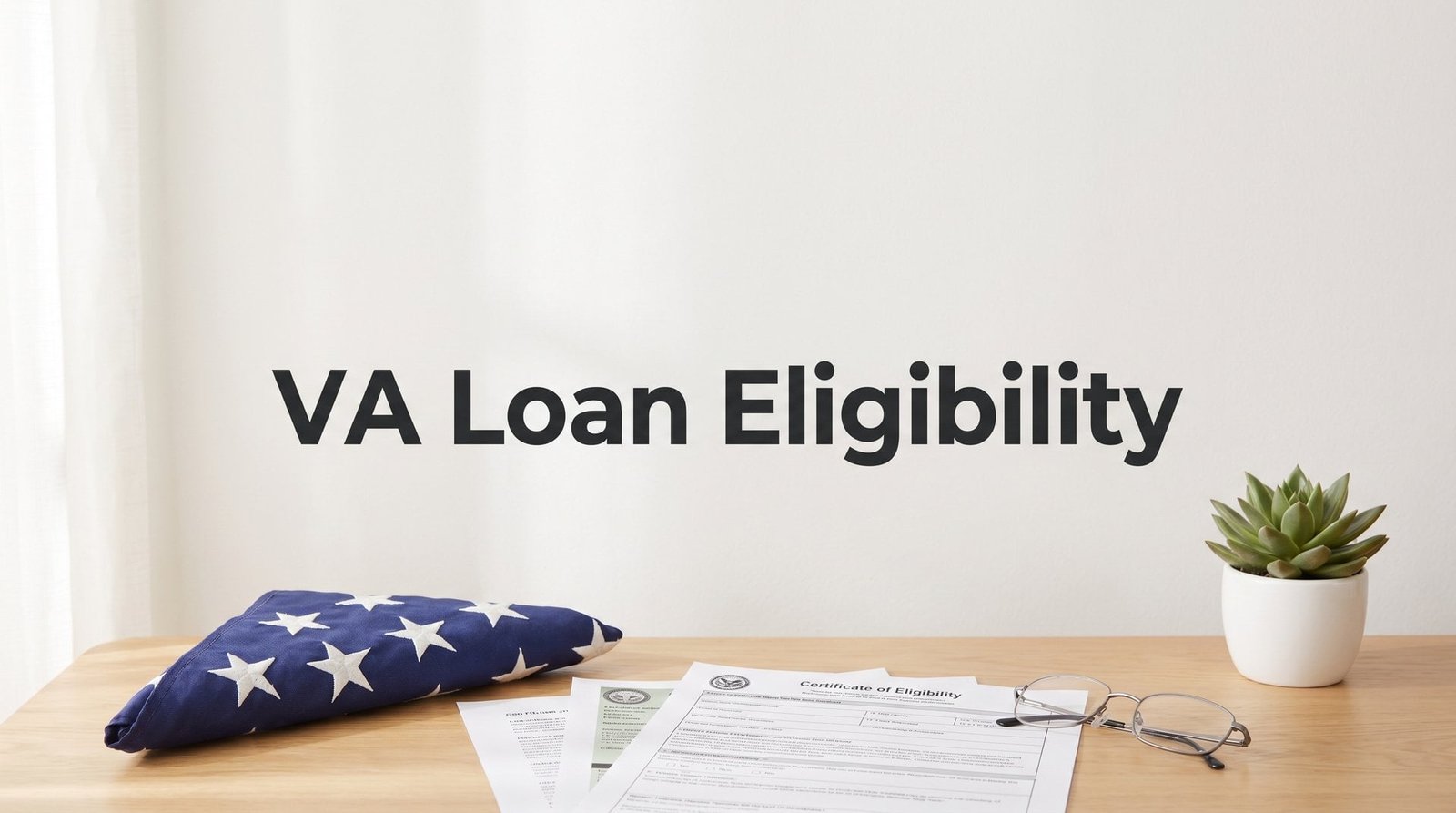
The Certificate of Eligibility, or COE, is the official document that confirms to your lender that you meet the VA’s service requirements. Think of it as your admission ticket to the program. Lenders require it before they can process a VA loan application, but obtaining one is typically faster and easier than most veterans expect.
There are three ways to get your COE:
1. Online via VA.gov eBenefits: Veterans and service members can apply directly at VA.gov. The portal is connected to military service records and can often generate the COE immediately for veterans with complete records on file.
2. By mail using VA Form 26-1880: You can download and submit VA Form 26-1880 directly to the VA’s eligibility center. Processing times vary and this is the slowest method, but it’s available if online access is an issue.
3. Through your lender: This is the most practical route for most borrowers. Lenders with VA portal access can pull your COE electronically, often in minutes during the application process. A knowledgeable VA lender handles this routinely and can flag any entitlement issues before they become closing problems.
What the COE reveals is equally important. It shows your entitlement amount, whether you have full or partial entitlement, and whether you’ve used the VA loan benefit before. Understanding entitlement is important for borrowers who have had a prior VA loan.
Full Entitlement means you’ve never used your VA loan benefit, or you’ve used it and fully paid off the prior VA loan and had the entitlement restored. Borrowers with full entitlement have no VA loan limit as of January 1, 2020, under the Blue Water Navy Vietnam Veterans Act of 2019. This means you can purchase a home at any price point without a down payment requirement imposed by the VA, though lenders may have their own product guidelines for higher loan amounts.
Reduced or Partial Entitlement occurs when a borrower has an active VA loan or previously used the benefit without full restoration. In these cases, county-level conforming loan limits become relevant. For Virginia, the 2025 conforming loan limit is $806,500 in most counties, reflecting FHFA guidelines. Borrowers with partial entitlement may need to make a down payment to cover the difference between the purchase price and the VA’s guaranty calculation.
The good news: VA entitlement can be restored after a prior VA loan is paid in full and the property is sold or the entitlement is formally restored through the VA. Borrowers who have used the benefit before and want to use it again should request an entitlement restoration through the VA, a process your lender can help initiate. If you want to explore your options without impacting your credit, a no credit check prequalification is a smart first step.
Choosing a VA Lender in Virginia: Brokers vs. Direct Lenders
Once you understand your eligibility, the next decision is who you work with to actually get the loan. This is where the structure of the mortgage market matters, and where the difference between a broker and a direct lender has real financial consequences.
A mortgage broker does not lend money directly. Instead, a broker shops your loan profile across a network of wholesale lenders simultaneously, presenting your file to many institutions at once to find the best rate and terms available for your specific situation. A direct lender, by contrast, offers only their own products. They may have competitive pricing on any given day, but you’re limited to what that single institution can offer. Understanding which mortgage lender to choose is one of the most consequential decisions in the homebuying process.
The table below provides an honest comparison. This is not a critique of any competitor: it’s a structural description of how different business models work.
VA Lender Comparison: Broker vs. Direct Lenders
Mortgage Mastermind (Broker | NMLS#1110647): Shops hundreds of wholesale lenders | NoTouch Credit (soft pull pre-qualification, no credit hit) | Deep local Virginia market knowledge across Richmond, Hampton Roads, Fredericksburg, Charlottesville, Roanoke | Competitive close times | Personalized, relationship-based service | Realtor partnership network in Virginia markets
Veterans United: Nation’s largest VA lender by volume | Direct lender, offers own products only | Strong VA specialization and veteran-focused resources | Hard credit pull typically required for pre-approval | National scale, less local market granularity
Rocket Mortgage: Largest retail mortgage lender nationally | Direct lender, technology-forward digital experience | Broad product menu | Hard credit pull at application | National pricing, limited local relationship infrastructure
Freedom Mortgage: High VA loan volume nationally | Direct lender | Strong VA IRRRL refinance presence | Hard credit pull at application | National servicing model
Atlantic Bay Mortgage: Regional presence in Virginia | Direct lender | Familiarity with Southeast markets | Hard credit pull at application | More localized than national players
CapCenter (Virginia-based): Known for low-fee structure | Direct lender | Virginia-focused | Hard credit pull at application | No-closing-cost model available
Fairway Independent Mortgage: Large independent lender | Direct lender | Broad product menu including VA | Hard credit pull at application | National scale with some regional presence
The honest summary: large direct lenders like Veterans United and Rocket Mortgage have invested heavily in technology, brand recognition, and veteran-specific resources. They are legitimate options. The structural limitation is that they can only offer you their own pricing. A broker’s value proposition is breadth: when you work with a broker, you’re not choosing one lender’s rate. You’re accessing the competitive output of hundreds of lenders simultaneously.
For Virginia-specific transactions, local market knowledge also matters in practical ways. Appraisal familiarity in Henrico County, title company relationships in Chesterfield, and realtor networks in the Richmond metro or Williamsburg corridor can affect closing timelines and transaction smoothness in ways that a national call-center model may not replicate. Effective mortgage rate comparison across multiple lenders is one of the clearest advantages of the broker model.
The VA Funding Fee: Running the Breakeven Math Before You Close
The VA funding fee is a one-time charge paid to the VA that helps sustain the loan program for future generations of veterans. It is not paid to your lender. It can be financed into the loan amount or paid at closing. Understanding the fee structure, and running the actual math against alternatives, is essential before you commit.
VA Funding Fee Schedule (Source: VA.gov, 2025–2026 schedule; verify current rates at VA.gov before closing)
First Use, 0% Down: 2.15% of loan amount
First Use, 5% or more Down: 1.50% of loan amount
First Use, 10% or more Down: 1.25% of loan amount
Subsequent Use, 0% Down: 3.30% of loan amount
Subsequent Use, 5% or more Down: 1.50% of loan amount
Subsequent Use, 10% or more Down: 1.25% of loan amount
Exemptions: Veterans with a VA-rated service-connected disability, surviving spouses receiving Dependency and Indemnity Compensation (DIC), and Purple Heart recipients serving on active duty are fully exempt from the funding fee. This exemption can represent thousands of dollars in savings and should be confirmed on your COE before closing.
Now let’s run the breakeven math. This is a hypothetical illustration using a $350,000 purchase price in the Richmond metro area. The numbers below are for educational illustration only and do not represent a rate quote or guarantee.
Scenario A: VA Loan, First Use, 0% Down
Purchase price: $350,000 | Down payment: $0 | Funding fee (2.15%): $7,525 | Loan amount (fee rolled in): $357,525 | Assumed rate: 6.75% (illustrative) | Estimated principal and interest payment: approximately $2,319/month | PMI: $0
Scenario B: Conventional Loan, 5% Down
Purchase price: $350,000 | Down payment: $17,500 | Loan amount: $332,500 | Assumed rate: 7.00% (illustrative; conventional rates typically price higher for lower down payment borrowers) | Estimated principal and interest payment: approximately $2,213/month | PMI estimate (0.70% annually on loan balance): approximately $194/month | Total estimated monthly cost: approximately $2,407/month
Monthly difference: Conventional scenario costs approximately $88/month more when PMI is included.
Breakeven calculation: The VA borrower paid a $7,525 funding fee that the conventional borrower did not pay. Divide $7,525 by $88/month savings = approximately 85 months, or just over 7 years, to fully recover the funding fee through monthly savings.
However, this math changes significantly if you qualify for a funding fee exemption (breakeven is immediate), if you put 5% or more down on the VA loan (reducing the fee to 1.50%), or if PMI on the conventional loan is higher due to credit profile. For a deeper look at the tradeoffs between loan types, our guide on FHA vs conventional loans walks through similar comparative analysis. Run this calculation with your specific numbers before assuming one product is automatically better than the other.
The core insight: for borrowers who plan to stay in the home beyond the breakeven horizon, and especially for those exempt from the funding fee, the VA loan’s long-term cost advantage is typically substantial. You can also review our breakdown of mortgage closing costs in Virginia to understand the full picture of what you’ll pay at the closing table.
Frequently Asked Questions About VA Loan Eligibility
Q: Can I use my VA loan benefit more than once?
A: Yes. The VA loan benefit is not a one-time entitlement. You can reuse it as long as your prior VA loan has been paid off and the entitlement has been restored, or in some cases, you can have two VA loans simultaneously if you have sufficient remaining entitlement. Subsequent use funding fees are higher (3.30% with no down payment), so the math should be reviewed carefully.
Q: Do I need a perfect credit score to qualify for a VA loan?
A: No. The VA itself sets no minimum credit score. Lenders set their own floors, commonly in the 580–640 range. A mortgage broker shopping hundreds of lenders can often find VA-approved options for borrowers across a wider credit spectrum than a single direct lender can offer.
Q: Can I buy a condo or manufactured home with a VA loan?
A: Condominiums must be in a VA-approved condominium project. You can check VA condo approval status at VA.gov. Manufactured homes are eligible under specific conditions, including that the home must be permanently affixed to a foundation and meet VA property requirements. Both property types involve additional underwriting steps.
Q: I served in the National Guard but was never deployed. Do I still qualify?
A: Possibly. National Guard members who completed 6 years of service in the Selected Reserve or National Guard may be eligible. Additionally, Guard members who were activated under Title 10 federal orders for 90 days or more may qualify under that threshold. Your COE will confirm your specific eligibility status.
Q: Can my spouse’s income count even if they’re not a veteran?
A: Yes. Non-veteran co-borrower income can be counted toward qualifying income on a VA loan. The loan is still a VA loan as long as the veteran is on the loan. Note that a non-veteran co-borrower’s portion of the loan is not covered by the VA guaranty, which affects the funding fee calculation. Your lender can walk through the specific implications for your file.
Q: What is an IRRRL and how does it relate to VA eligibility?
A: The Interest Rate Reduction Refinance Loan, commonly called the IRRRL or VA Streamline Refinance, is available to veterans who already have a VA loan and want to refinance to a lower rate. It requires minimal documentation, no appraisal in most cases, and no income verification. If you purchased with a VA loan and rates have moved in your favor, the IRRRL is typically the most efficient refinance path. For current guidance on this program, see our detailed breakdown of VA IRRRL rates. The funding fee for an IRRRL is 0.50% of the loan amount, significantly lower than purchase fees.
Q: How does a VA loan compare to a USDA loan for rural Virginia buyers?
A: Both programs offer zero-down-payment options, but they serve different populations. USDA loans are available to any qualified buyer in eligible rural areas, regardless of military service, but are subject to household income limits and geographic eligibility requirements. VA loans have no income ceiling and no geographic restriction. For veterans buying in rural Virginia communities like Lake Anna, Louisa County, Caroline County, or Goochland, both programs may be worth evaluating. Our comprehensive guide to USDA rural housing loans covers the full eligibility criteria and program details. USDA eligibility maps are available at USDA.gov. A broker can run both scenarios side by side to show which program produces better terms for your specific file.
Q: What Virginia counties see the highest VA loan usage?
A: Hampton Roads communities, including Virginia Beach, Chesapeake, Newport News, and Suffolk, consistently see high VA loan utilization given the region’s large active-duty and veteran population. The Fredericksburg, Stafford, and Spotsylvania corridor also has strong VA loan activity. Richmond-area counties including Henrico, Chesterfield, and Hanover see consistent VA volume as well.
Moving Forward: Your First Step Is Simpler Than You Think
VA loan eligibility is more accessible than many veterans realize. If you served the required minimum time, received an honorable or qualifying discharge, and intend to occupy the home you’re purchasing, there’s a strong likelihood you have a benefit waiting to be used. The funding fee structure is manageable, the credit requirements are more flexible than conventional financing, and the absence of PMI creates long-term cost advantages that compound over the life of the loan.
The first concrete action is obtaining your Certificate of Eligibility. You can start at VA.gov, or work with a lender who can pull it electronically in minutes. From there, the conversation shifts to rates, lenders, and which program fits your specific financial picture.
When you’re ready to explore your options, working with a lender who shops broadly, protects your credit during the exploration phase with a soft pull pre-qualification, and has genuine familiarity with Virginia’s local markets gives you a structural advantage over working with a single institution’s product menu.
If you’re in Virginia, Florida, Tennessee, or Georgia and want to understand your VA loan options without a credit hit and without pressure, learn more about our services and how we approach the VA loan process on your behalf.
Author: Duane Buziak, Mortgage Maestro, NMLS#1110647
Legal Disclaimer: This article is for educational purposes only and does not constitute financial or legal advice. Mortgage Mastermind is not affiliated with or endorsed by the U.S. Department of Veterans Affairs. All loan programs, rates, terms, and eligibility requirements are subject to change without notice and are determined by individual lenders and applicable guidelines at the time of application. VA funding fee percentages and service requirement thresholds are based on current VA guidelines and should be verified at VA.gov prior to application. Mortgage Mastermind is licensed to originate mortgage loans in Virginia, Florida, Tennessee, and Georgia only. NMLS#1110647. Equal Housing Lender.

One Comment
[…] your current entitlement position before applying is not optional, it is foundational. Your Certificate of Eligibility will show your available entitlement, but interpreting it correctly, especially with partial […]