
Choosing an FHA lender is one of the most consequential financial decisions you’ll make as a homebuyer, and it’s one where most people leave money on the table. FHA loans, insured by the Federal Housing Administration, allow for down payments as low as 3.5% and more flexible credit requirements than conventional financing. But here’s what many Virginia homebuyers don’t realize: while FHA guidelines are set federally, each lender sets its own interest rates, overlays, closing costs, and processing timelines.
Two lenders offering the same FHA product can differ by thousands of dollars over the life of your loan. Whether you’re buying your first home in Richmond, refinancing in Chesapeake, or relocating to Fredericksburg, a disciplined lender comparison process is essential.
This guide walks you through seven concrete strategies, complete with breakeven math, rate payment tables, and head-to-head comparison frameworks, so you can evaluate FHA lenders with confidence across Virginia, Florida, Tennessee, and Georgia. No sales pitch. Just the educational framework you need to make the right call.
Author: Duane Buziak, Mortgage Maestro, NMLS#1110647
1. Build an Apples-to-Apples Rate and Fee Comparison Table
The Challenge It Solves
Most borrowers compare FHA lenders by looking at the interest rate alone. That’s like comparing two cars by looking only at the sticker price and ignoring fuel costs, insurance, and maintenance. The advertised rate tells you almost nothing about what you’ll actually pay. To make a real comparison, you need a structured table that forces every lender to show their full cost picture side by side.
The Strategy Explained
When you request a Loan Estimate from each lender (which lenders are required to provide within three business days of a completed application under RESPA), you’ll have a standardized document you can use to build your comparison table. The key fields to extract and compare are: interest rate, APR, origination charges, discount points, third-party fees, estimated monthly payment, and total closing costs.
The APR is particularly important because it folds most lender fees into a single annualized percentage, making it easier to compare the true cost of two loans with different rate-and-fee combinations. A lender offering a lower rate but charging two points may actually cost more than a lender offering a slightly higher rate with no points. For a deeper dive into evaluating rate offers, see our guide on mortgage rate comparison strategies that can save you thousands.
Implementation Steps
1. Contact at least three to five FHA lenders and request a Loan Estimate using the same loan scenario: identical purchase price, down payment, loan amount, property type, and credit profile.
2. Extract these fields from each Loan Estimate into a spreadsheet: interest rate, APR, origination fee, discount points (in dollars), estimated monthly principal and interest, MIP, taxes and insurance escrow, and total cash to close.
3. Use the table below as a model for your side-by-side comparison.
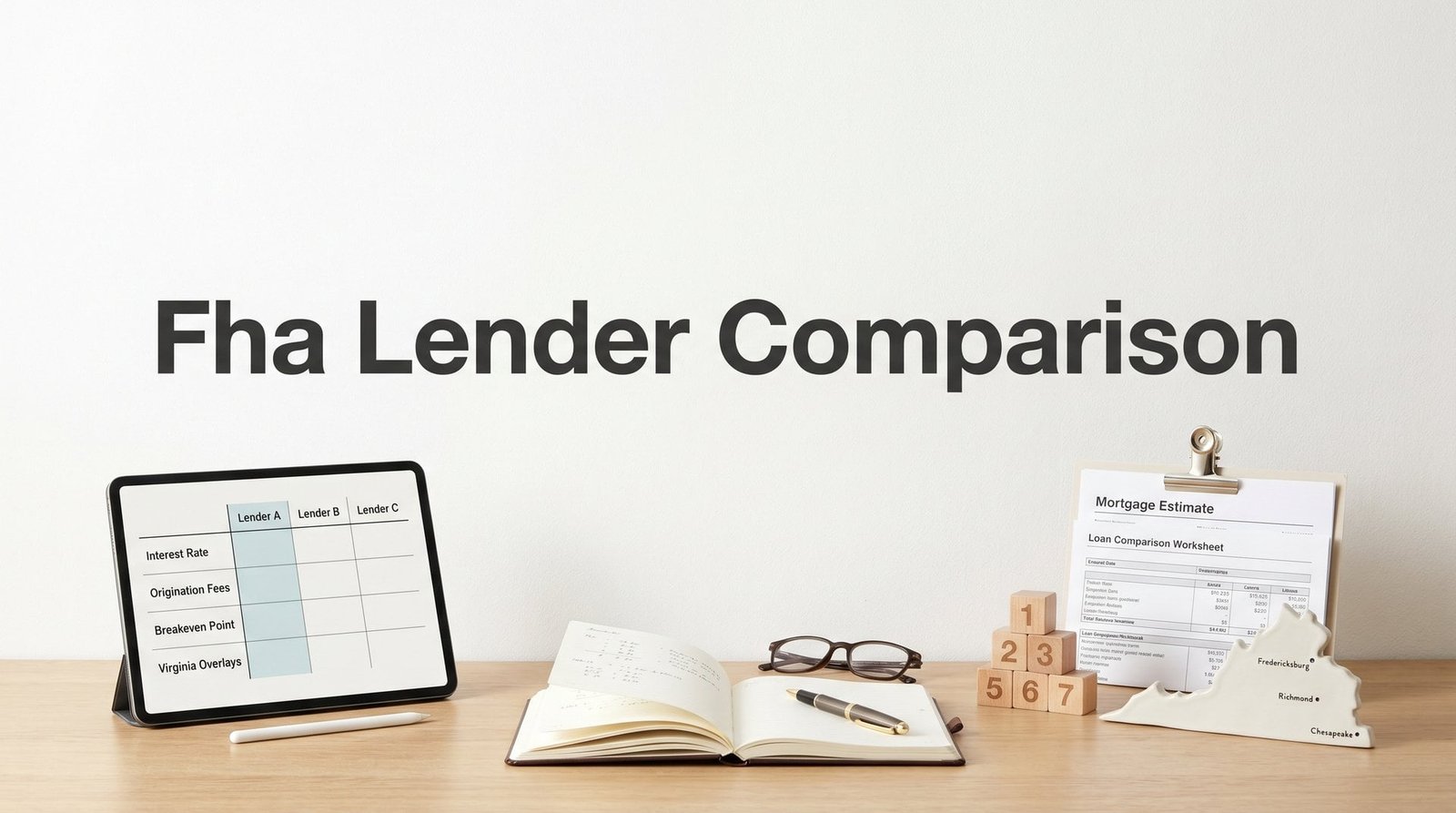
Sample FHA Lender Comparison Table (Hypothetical Illustration)
Loan Amount: $350,000 | Term: 30-Year Fixed | LTV: 96.5%
Lender A: Rate 6.75% | APR 7.62% | Points 0 | Origination Fee $1,500 | Monthly P&I $2,270 | MIP (monthly) $189 | Total Monthly $2,459 | Closing Costs $7,200
Lender B: Rate 6.50% | APR 7.55% | Points 1 ($3,500) | Origination Fee $1,000 | Monthly P&I $2,213 | MIP (monthly) $189 | Total Monthly $2,402 | Closing Costs $10,100
Lender C: Rate 6.875% | APR 7.48% | Points 0 | Origination Fee $0 | Monthly P&I $2,299 | MIP (monthly) $189 | Total Monthly $2,488 | Closing Costs $5,400
Notice that Lender C has the highest rate but the lowest closing costs, while Lender B has the lowest rate but the highest upfront cost. Which is best for you depends entirely on how long you plan to stay in the home, which leads directly to Strategy 3.
Pro Tips
Always request Loan Estimates on the same day or within the same week. Rates move daily, and comparing a quote from Monday to one from Friday introduces market noise that distorts your comparison. Lock in your comparison window to get a clean read on true lender cost differences rather than market fluctuations.
2. Use Credit-Safe Pre-Qualification to Shop Without Score Damage
The Challenge It Solves
One of the most common reasons Virginia homebuyers limit themselves to one or two lenders is fear of damaging their credit score by allowing multiple inquiries. This concern is understandable but largely misplaced when you understand how credit scoring models actually treat mortgage shopping. Letting this fear prevent you from comparing lenders is one of the most expensive mistakes you can make.
The Strategy Explained
FICO scoring models include a “rate shopping” provision that treats multiple mortgage-related hard inquiries within a defined window as a single inquiry for scoring purposes. According to FICO (fico.com), the current shopping window under FICO Score 8 and newer models is 45 days, while older models use a 14-day window. This means you can apply with multiple FHA lenders within that window and your score will be treated as if only one inquiry occurred.
Beyond this, many lenders, including Mortgage Mastermind, now offer no credit check prequalification using soft-pull technology. A soft pull uses your Vantage Score 4.0 to generate a preliminary assessment of your loan eligibility without any impact to your credit score whatsoever. This allows you to get a realistic picture of your options before committing to a formal application anywhere.
Implementation Steps
1. Begin your lender search with soft-pull pre-qualifications to identify which lenders can realistically serve your profile before any hard inquiries occur.
2. Once you’ve narrowed your list to your top three to five candidates, submit formal applications within the same 45-day window to consolidate all hard inquiries into a single scoring event.
3. Monitor your credit through a free tool like AnnualCreditReport.com before and after shopping to confirm the expected minimal impact.
Pro Tips
Ask each lender explicitly whether their pre-qualification process uses a hard pull or soft pull before providing your Social Security number. Lenders who default to a hard pull at the pre-qualification stage are adding unnecessary risk to your credit profile. A lender who respects your credit from the first interaction is demonstrating the kind of transparency you want throughout the process.
3. Run the Breakeven Math on Points and Buydowns
The Challenge It Solves
Discount points are one of the most misunderstood elements of a mortgage offer. Some lenders lead with a low rate that looks compelling, but that rate is only achievable by paying points upfront. Others offer lender credits that reduce your closing costs but raise your rate. Without running the breakeven math, you cannot know which option actually saves you money given your specific timeline.
The Strategy Explained
The breakeven calculation answers one question: how many months does it take for your monthly savings to equal the upfront cost you paid to achieve them? If you plan to stay in the home longer than the breakeven period, buying points makes sense. If you plan to sell or refinance before that point, you’re better off with a higher rate and lower upfront cost.
Here’s the worked math using a clearly labeled hypothetical scenario based on realistic current market parameters.
Breakeven Math: Hypothetical Illustration
Scenario: FHA loan, $350,000 purchase, 3.5% down, loan amount $337,750, 30-year fixed.
Option A (No Points): Rate 6.875% | Monthly P&I $2,218 | Upfront cost $0
Option B (1 Point = $3,378): Rate 6.625% | Monthly P&I $2,164 | Upfront cost $3,378
Monthly Savings with Option B: $2,218 minus $2,164 = $54 per month
Breakeven Period: $3,378 divided by $54 = 62.6 months, or approximately 5 years and 3 months
Interpretation: If you stay in this home beyond 63 months, Option B saves you money. If you sell or refinance before that point, Option A was the better choice.
Lender Credit Scenario (Negative Points):
Option C (Lender Credit of $3,000): Rate 7.125% | Monthly P&I $2,274 | Closing cost reduction $3,000
Monthly Cost vs. Option A: $2,274 minus $2,218 = $56 more per month
Breakeven Period: $3,000 divided by $56 = 53.6 months, or approximately 4 years and 5 months
Interpretation: Option C reduces your cash at closing by $3,000 but costs you $56 more per month. If you expect to refinance within 54 months, this trade-off works in your favor.
Implementation Steps
1. For every lender quote that includes points or credits, record the monthly payment difference and the upfront dollar amount.
2. Divide the upfront cost by the monthly savings (or divide the credit received by the monthly cost increase) to calculate your breakeven in months.
3. Compare that breakeven period against your honest estimate of how long you’ll keep this loan before selling or refinancing. Understanding mortgage closing costs in detail will help you evaluate the full upfront expense picture alongside your breakeven analysis.
Pro Tips
Be honest with yourself about your timeline. Many homebuyers in growing Virginia markets like Short Pump, Midlothian, and the Fredericksburg corridor refinance within three to five years as their equity grows and rates shift. If that’s your realistic scenario, paying points rarely makes financial sense regardless of how attractive the lower rate looks on paper.
4. Compare Lender Types: Broker vs. Direct Lender vs. Bank
The Challenge It Solves
Not all FHA lenders access the mortgage market the same way. The type of institution you work with determines how many rate options you can see, how much flexibility exists in underwriting, and ultimately how competitive your offer will be. Many borrowers don’t realize there’s a structural difference between these lender types, let alone how to use that difference to their advantage.
The Strategy Explained
Understanding the three primary lender categories helps you know what you’re working with before you start comparing quotes.
Mortgage Brokers: A broker does not lend their own money. Instead, they shop your loan file across a network of wholesale lenders, which can include hundreds of institutions. Because wholesale rates are typically lower than retail rates, brokers often deliver more competitive pricing. They also have access to multiple underwriting guidelines, which can be valuable if your file has complexity. Mortgage Mastermind operates as a broker, providing access to hundreds of lenders at once, which means your loan is shopped competitively rather than offered at a single institution’s retail rate.
Direct Lenders: Companies like Rocket Mortgage, Freedom Mortgage, and Guild Mortgage lend their own money and underwrite in-house. They offer speed and consistency but are limited to their own product set and pricing. Their rates reflect retail margins. Rocket Mortgage, for example, is a well-known direct lender with robust technology and fast processing, but borrowers work within one institution’s rate structure and overlays. For more guidance on evaluating these differences, our article on which mortgage lender to choose breaks down the decision framework in detail.
Banks and Credit Unions: Traditional banks and credit unions originate FHA loans through their own portfolio or sell them to the secondary market. Their rates and overlays vary widely. Some offer relationship discounts for existing customers; others are less competitive on FHA-specific products.
Implementation Steps
1. When contacting lenders, ask directly: “Are you a broker, direct lender, or bank?” This tells you immediately how many rate options you’re accessing.
2. Ask brokers specifically: “How many wholesale lenders do you shop for FHA loans?” A broker with access to a large lender network provides more competitive rate discovery than one with limited relationships.
3. Compare at least one broker quote against at least one direct lender quote to see the real-world pricing difference for your specific scenario.
Pro Tips
Movement Mortgage, Atlantic Bay Mortgage, and CrossCountry Mortgage are well-known direct lenders active in Virginia markets including Richmond, Hampton Roads, and Charlottesville. They offer solid service and local presence. The honest comparison is that a broker with a large wholesale network may surface more competitive pricing, while a direct lender may offer faster in-house underwriting decisions. Neither is universally superior; your file’s complexity and your timeline determine which structure serves you better.
5. Evaluate FHA-Specific Overlays and Underwriting Flexibility
The Challenge It Solves
Here’s something that surprises many first-time FHA borrowers: the FHA sets minimum guidelines, but lenders are free to add their own more restrictive requirements on top of those minimums. These additions are called overlays. A lender with aggressive overlays may decline your file even though you fully qualify under FHA rules. Comparing lenders without understanding their overlays means you might choose a lender who can’t actually approve your loan.
The Strategy Explained
According to HUD Handbook 4000.1 (available at hud.gov), FHA’s published minimums include a 580 credit score for 3.5% down financing and a 500 credit score for 10% down financing. FHA also permits debt-to-income ratios above 50% with compensating factors, and allows manual underwriting for borrowers who don’t meet automated approval standards.
In practice, many lenders impose overlays that are significantly more restrictive. Common examples include requiring a minimum 620 or even 640 credit score regardless of FHA’s 580 floor, capping DTI at 45% or 50% even when FHA would allow higher with compensating factors, and declining to offer manual underwriting at all. Understanding your debt to income ratio and how different lenders evaluate it is essential to navigating these overlay differences.
Implementation Steps
1. Ask each lender: “What is your minimum credit score for FHA loans?” If the answer is above 580, that lender has a credit score overlay. This matters if your score is between 580 and the lender’s minimum.
2. Ask: “What is your maximum DTI for FHA approval?” Compare this to FHA’s published guidelines. A lender who caps at 43% is more restrictive than one who follows FHA’s actual standards.
3. Ask: “Do you offer FHA manual underwriting?” Manual underwriting is critical for borrowers with non-traditional credit, recent credit events, or thin files. Lenders who don’t offer it are limiting your options.
Pro Tips
Lenders like CapCenter and PrimeLending, both active in Virginia markets, operate as direct lenders with their own overlay structures. Fairway Independent Mortgage and Alcova Mortgage similarly set their own internal guidelines. When comparing these lenders against a broker who can route your file to the wholesale lender with the most favorable overlays for your profile, the difference in qualification flexibility can be significant. The key is asking the right questions rather than assuming all FHA lenders operate identically.
6. Factor In Closing Timeline and Local Market Responsiveness
The Challenge It Solves
In competitive Virginia real estate markets, closing speed matters. A seller in Glen Allen or Chesterfield choosing between two offers at similar prices will often favor the buyer whose lender has a strong track record of closing on time. An FHA lender who takes 50 days to close when the market standard is 30 to 35 days can cost you the home entirely. Timeline is not a soft factor; it’s a competitive variable that belongs in your lender comparison.
The Strategy Explained
FHA loans have historically carried a reputation for longer closing timelines than conventional loans, partly because FHA appraisals have specific property condition requirements that can generate repair requests. But the reality is that closing speed varies enormously by lender, not just by loan type. A well-organized lender with strong FHA volume and experienced processors can close an FHA loan in 21 to 30 days. An understaffed or less experienced lender might take 45 to 60 days on the same file. Our guide on the fast mortgage approval process outlines specific steps you can take to accelerate your timeline regardless of lender.
Local market responsiveness is equally important. Virginia’s diverse markets, from the Richmond metro to Hampton Roads to the Fredericksburg and Stafford corridor, each have their own title company ecosystems, appraisal pools, and local market nuances. A lender who regularly closes loans in Henrico County will navigate the local appraisal and title process more smoothly than a national lender processing your file from a call center in another state.
Implementation Steps
1. Ask each lender: “What is your average days-to-close on FHA purchase loans in the last 90 days?” This is a concrete, answerable question that reveals operational capacity.
2. Ask: “Do you have processors and loan officers familiar with Virginia title requirements, FHA appraisal standards, and local market conditions?” Local familiarity reduces the risk of last-minute surprises.
3. Ask your real estate agent which lenders they’ve seen perform reliably in your target market. Realtors in Midlothian, Hanover, and Williamsburg have direct experience with which lenders close on time and which ones generate problems at the closing table.
Pro Tips
Veterans United is well-known for VA loan efficiency, and NFM Lending has a notable presence in Virginia markets, but their FHA-specific processing timelines may differ from their VA performance. Southern Trust Mortgage and Embrace Home Loans are regional players with Virginia familiarity. When evaluating any lender, ask specifically about FHA timelines rather than overall averages, since lender performance often varies by loan type.
7. Demand Transparency on FHA Mortgage Insurance Costs
The Challenge It Solves
FHA mortgage insurance is one of the most significant long-term costs of an FHA loan, and it’s one that many borrowers don’t fully understand until after closing. Unlike conventional PMI, which can be canceled once you reach 20% equity, FHA mortgage insurance behaves differently depending on your loan terms. Without understanding exactly what you’re paying and for how long, you cannot make a fully informed comparison between FHA lenders, or between FHA and conventional financing.
The Strategy Explained
FHA mortgage insurance has two components, both published by HUD (hud.gov).
Upfront Mortgage Insurance Premium (UFMIP): Currently 1.75% of the base loan amount, paid at closing or rolled into the loan. On a $337,750 loan, this equals $5,911 upfront (or added to the loan balance).
Annual Mortgage Insurance Premium (Annual MIP): Varies by loan term, LTV, and loan amount. For a 30-year FHA loan with less than 10% down (LTV above 90%), the annual MIP is currently 0.55% of the outstanding loan balance per year, charged monthly. This rate is verified at hud.gov and is subject to change by HUD.
Worked MIP Math: Hypothetical Illustration
Loan Amount: $337,750 (after 3.5% down on $350,000 purchase)
UFMIP (1.75%): $5,911 rolled into loan, making the financed amount $343,661
Annual MIP (0.55%): $343,661 x 0.0055 = $1,890 per year, or $157.50 per month
Duration: For loans with less than 10% down on a 30-year term, FHA MIP continues for the life of the loan. This means you pay $157.50 per month every month until you refinance, sell, or pay off the loan entirely.
FHA MIP vs. Conventional PMI Comparison
FHA MIP (30-year, 3.5% down, $337,750 loan): $157.50/month | Duration: Life of loan | Cancelable: No (without refinancing)
Conventional PMI (same scenario, 760 credit score, varies by insurer): Approximately $100 to $175/month depending on credit score and insurer | Duration: Until 20% equity reached | Cancelable: Yes, by request at 20% equity, automatic at 22%
Key Insight: If you have a credit score of 680 or above and can qualify for conventional financing, running a side-by-side comparison of total MIP versus PMI costs over your expected ownership period is essential. Our detailed guide on FHA vs conventional loans walks through this comparison framework for Virginia borrowers in multiple scenarios.
Implementation Steps
1. Ask each FHA lender to provide a written breakdown of both UFMIP and annual MIP in dollar terms, not just percentages, so you can see the real monthly impact.
2. Ask whether your loan scenario qualifies for the 10% down MIP structure, which reduces the MIP duration to 11 years rather than the life of the loan, if you can stretch your down payment.
3. Request a side-by-side comparison of FHA versus conventional financing for your credit profile to determine whether FHA is actually the lower-cost option for your specific situation.
Pro Tips
Some lenders, particularly those with less FHA volume, will present MIP as a minor line item rather than a significant long-term cost. Insist on seeing the total MIP paid over your expected ownership period in addition to the monthly figure. Over a seven-year ownership period on the example above, annual MIP alone totals more than $13,000. That number deserves to be front and center in your comparison, not buried in fine print.
Putting It All Together: Your FHA Lender Comparison Checklist
You now have a complete framework for evaluating FHA lenders the way a financially sophisticated borrower should. Let’s consolidate it into a practical checklist you can use starting today.
Your 7-Point FHA Lender Comparison Checklist:
1. Build a side-by-side Loan Estimate comparison table covering rate, APR, fees, points, and total monthly payment from at least three to five lenders.
2. Start with soft-pull pre-qualifications to protect your credit score, then submit formal applications within the same 45-day shopping window.
3. Run breakeven math on every point and lender credit scenario to determine which pricing structure matches your ownership timeline.
4. Identify whether each lender is a broker, direct lender, or bank, and understand how that affects your rate access and underwriting flexibility.
5. Ask directly about credit score minimums, DTI caps, and manual underwriting availability to identify lenders whose overlays match your profile.
6. Ask for average FHA days-to-close and confirm local Virginia market familiarity before committing to a lender in competitive markets like Richmond, Chesapeake, or Fredericksburg.
7. Get MIP costs in writing in dollar terms, compare FHA versus conventional total costs, and understand whether MIP is a life-of-loan or limited-duration obligation for your specific scenario.
The best FHA lender comparison is one that accounts for all seven dimensions holistically. A lender who wins on rate but loses on overlays, timeline, or MIP transparency may not actually be the best choice for your situation.
The most risk-free starting point is a credit-safe, NoTouch pre-qualification that gives you a realistic picture of your options without any impact to your credit score. From there, you can build your comparison table with real numbers and make your decision from a position of knowledge rather than guesswork.
To learn more about how Mortgage Mastermind approaches FHA lending across Virginia, Florida, Tennessee, and Georgia, learn more about our services and start your credit-safe pre-qualification today.
Frequently Asked Questions: FHA Lender Comparison
Q: Can I apply with multiple FHA lenders without hurting my credit score?
A: Yes. FICO scoring models treat multiple mortgage-related hard inquiries within a 45-day window as a single inquiry for scoring purposes (source: fico.com). Additionally, many lenders now offer soft-pull pre-qualification that generates no credit impact at all, allowing you to explore your options before committing to a formal application.
Q: What is the minimum credit score for an FHA loan?
A: According to HUD Handbook 4000.1 (hud.gov), FHA’s published minimum is 580 for 3.5% down financing and 500 for 10% down financing. However, many individual lenders impose overlays requiring scores of 620 or higher. Always ask each lender about their specific minimum, not just the FHA floor.
Q: How long do I pay FHA mortgage insurance?
A: For FHA loans with less than 10% down on a 30-year term, annual MIP continues for the life of the loan. For loans with 10% or more down, MIP duration is limited to 11 years. This is a critical distinction that affects the long-term cost comparison between FHA and conventional financing.
Q: What is the difference between a mortgage broker and a direct lender for FHA loans?
A: A mortgage broker shops your loan across multiple wholesale lenders, which can mean access to more competitive pricing and underwriting options. A direct lender underwrites and funds loans using their own money and guidelines, which can offer speed and consistency but limits you to one institution’s rate structure and overlays. Neither is universally superior; the right choice depends on your credit profile, timeline, and how competitive you need the pricing to be.
Q: How do I compare FHA lenders in Virginia if I’m also considering conventional financing?
A: Request side-by-side comparisons of both loan types from each lender using the same purchase scenario. Key variables to compare include total monthly payment (including MIP versus PMI), total closing costs, breakeven timeline on any points, and the duration of mortgage insurance. Borrowers with credit scores above 680 and the ability to make a larger down payment may find conventional financing more cost-effective over a five-to-seven-year ownership horizon, even accounting for FHA’s typically lower base rate.
Legal Disclaimer: This content is provided for educational purposes only and does not constitute a commitment to lend, a loan approval, or financial advice. Mortgage rates, fees, and program availability are subject to change without notice and vary based on individual credit profiles, property type, loan amount, and market conditions. FHA mortgage insurance premium rates are set by HUD and are subject to change; verify current rates at hud.gov. All breakeven math examples in this article are hypothetical illustrations using realistic parameters and are not guarantees of actual loan terms. Mortgage Mastermind is licensed to originate mortgage loans in Virginia, Florida, Tennessee, and Georgia. This content is not directed toward residents of other states. Not all applicants will qualify for all loan programs. All loans are subject to underwriting approval. Duane Buziak, NMLS#1110647. Mortgage Mastermind, NMLS#[Company NMLS]. Equal Housing Lender.

One Comment
[…] loan DTI pressure, or credit scores in the 580–620 range. These are exactly the profiles where overlay differences between wholesale lenders are most consequential — and where a single-shelf lender is most likely to decline a file that a […]